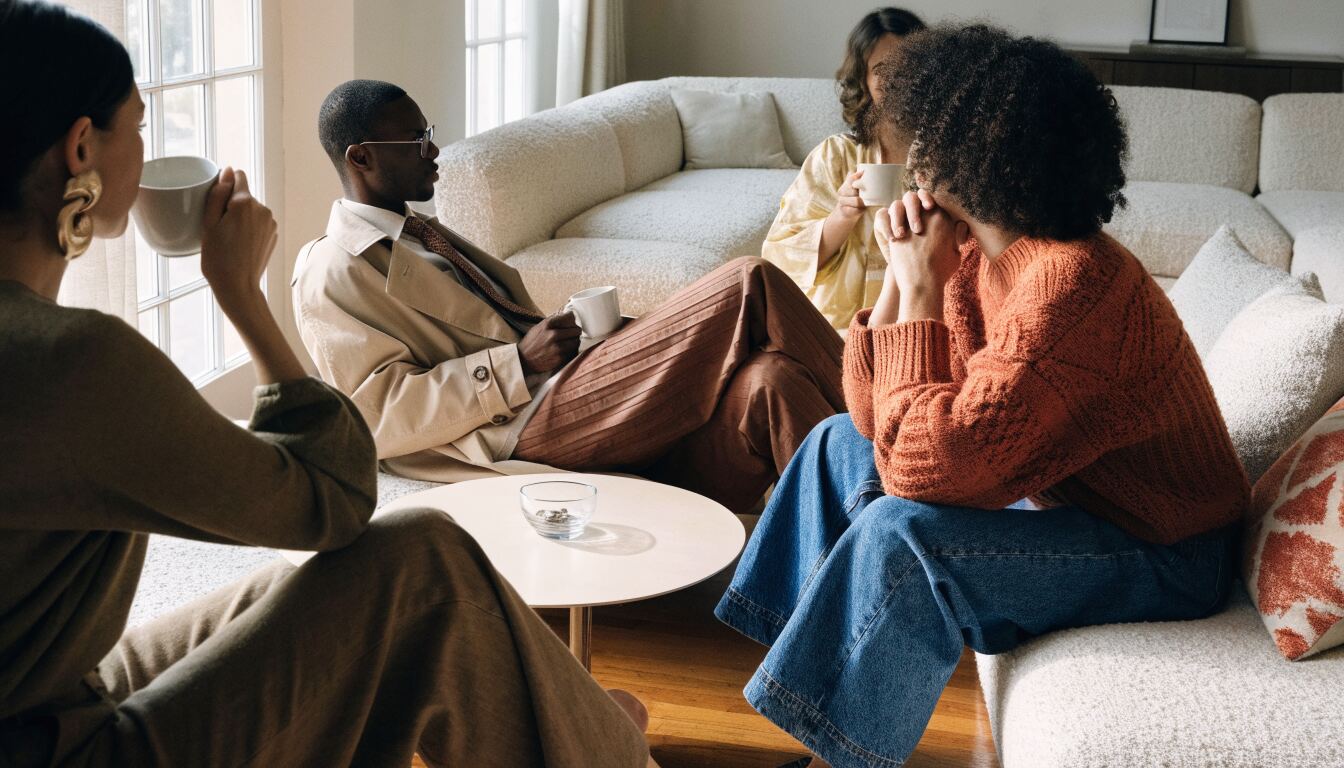
Walking Into a New Social Circle
Accepting an invitation to a couples-focused social evening can feel like stepping onto a stage you never rehearsed for. Your mind might race with questions: What do people actually talk about? How forward is too forward? Will I feel completely out of place? These thoughts are not only common—they are practically universal for anyone venturing into an environment where the usual dating scripts no longer apply. What you are about to experience is a gathering where the standard rules of monogamous coupling are gently set aside, replaced by a more fluid and conversational approach to connection.
This guide is built to walk you through every stage of that first evening, from the moment you pick out what to wear to the quiet reflection on the drive home. We will explore the emotional cocktail you are likely to feel, how to read the room and the people in it, and why clear, honest dialogue with your partner serves as the foundation for everything that follows. No two events are identical, but the principles of respect, curiosity, and self-awareness remain constant.
Most people arrive carrying a mix of societal baggage and genuine intrigue. You may have grown up absorbing the message that a committed relationship means closing the door to everyone else, so the very idea of attending a social event where that door is left ajar can stir up internal conflict. Yet there is also a part of you—perhaps a quiet but persistent part—that recognizes a wider spectrum of human desire. That recognition is not a flaw; it is a facet of who you are. The goal here is not to push you toward any particular outcome, but to help you navigate the evening with your comfort and integrity intact.
We will cover how to prepare emotionally, what communication rhythms work best before and during the event, and how to interpret the subtle signals that indicate mutual interest. We will also look at how these experiences can, for many people, deepen the trust within a primary partnership rather than weaken it. By the end, you will have a practical framework for approaching the evening with less anxiety and more grounded anticipation.
The Inner Weather Before You Arrive
Excitement and Nervousness Are Roommates
It is rare to feel pure, uncomplicated enthusiasm before your first lifestyle gathering. More often, excitement shares space with a flutter of apprehension. One moment you might picture the thrill of meeting new people and the next you feel a knot of uncertainty tightening in your chest. This duality is not a sign that you are on the wrong path; it simply means you are doing something unfamiliar. The human brain is wired to treat the unknown with caution, even when the unknown is something you consciously desire.
Think of it like preparing for a long-planned trip. You have researched the destination, you genuinely want to go, and yet the night before departure you lie awake wondering if you forgot something important. That restlessness does not cancel out the excitement—it coexists with it. Acknowledging both feelings gives you a more honest starting point. You can say to yourself, “I am eager to explore this, and I also feel a bit shaky, and both of those reactions belong.”
When Guilt Knocks on the Door
Many first-timers report an unexpected wave of guilt or shame, sometimes before the event even begins. This often has little to do with the actual experience and everything to do with the internalized voices of culture, family, or religion. You may logically believe that consensual exploration between adults is perfectly valid, yet still feel a pang of wrongdoing. That pang is emotional residue, not a moral compass.
One helpful practice is to separate the feeling from the judgment. Instead of thinking, “I feel guilty, therefore this must be wrong,” try, “I notice guilt is showing up. Where might that be coming from?” Often, simply identifying the source—old conditioning, fear of judgment, a protective instinct—robs the guilt of its power. You do not have to eliminate the feeling to move forward; you just need to stop letting it steer the wheel.
Recognizing That Desire Comes in Many Flavors
Human sexuality is wonderfully diverse. Some people crave novelty; others are drawn to emotional connection before anything physical; still others find their attraction sparked by a particular energy or sense of humor. Stepping into a social space that honors this diversity can be eye-opening. You may discover that your partner is intrigued by something you never expected, or that you yourself respond to a type of person you had not previously considered.
Accepting this variety without ranking it as better or worse is key. There is no hierarchy of valid desire. What matters is that you and your partner remain curious about each other’s inner world, even when it surprises you. Trying to force uniformity only leads to frustration. Instead, approach the evening with the mindset of an anthropologist: observe, learn, and appreciate the range of human expression around you.
Conversations That Build a Safety Net
Why Talking Everything Through Matters
If there is one practice that separates a stressful evening from a fulfilling one, it is communication. This does not mean a single check-in where you both agree “we will see how it goes.” It means multiple, honest, sometimes awkward conversations that cover hopes, fears, specific boundaries, and what you will do if either of you feels uncomfortable. Think of these talks as drawing a map together. The map does not dictate exactly where you will travel, but it ensures you both know where the emergency exits are and which areas are off-limits.
Before the event, set aside time when you are both relaxed and free of distractions. Ask open-ended questions: “What are you most curious about?” “Is there anything that makes you nervous?” “How would you like us to signal each other if we want to leave early?” Listen without interrupting, and resist the urge to minimize your partner’s concerns. Even if a fear seems irrational to you, it is real to them, and addressing it with patience builds trust.
Handling Awkward Moments Without Panic
No matter how thoroughly you prepare, moments of awkwardness will arise. Someone might misinterpret a friendly gesture, a conversation might stall, or you might suddenly feel out of your depth. The skill is not in avoiding these moments but in moving through them with composure. A simple, honest statement can work wonders. Saying “I need a moment to catch my breath” or “Let me check in with my partner” is perfectly acceptable. People in this space generally respect directness because they have been in your shoes.
If you accidentally say something that lands wrong, a brief apology followed by a change of topic is usually enough. Do not over-explain or dwell. Most attendees are not keeping score; they are navigating their own social terrain. Give yourself permission to be imperfect. The goal is connection, not performance.
Boundaries Are Not Barriers—They Are Guardrails
Personal limits come in many forms: physical, emotional, conversational. Some people are comfortable with flirtation but not touch. Others enjoy group conversations but prefer one-on-one intimacy to happen elsewhere. There is no universal standard, and your boundaries deserve as much respect as anyone else’s. Stating them clearly is not rude; it is an act of self-care and consideration for others.
Pay attention to nonverbal signals as well. If someone steps back, avoids eye contact, or gives short answers, take that as a cue to slow down or shift gears. Enthusiastic consent is the gold standard. Silence or passivity does not equal agreement. When everyone in the room operates with this awareness, the atmosphere becomes relaxed rather than pressured. You are not there to convince anyone; you are there to connect with those who are genuinely interested.
The Subtle Art of Mutual Attraction
What Draws People Together in This Setting
Attraction at a lifestyle gathering is rarely just about appearance. While physical chemistry certainly plays a role, other qualities often carry equal or greater weight. Confidence—the quiet kind, not the boastful kind—tends to draw people in. A warm smile, genuine curiosity about others, and the ability to listen well are magnetic traits. People want to feel seen and appreciated, not evaluated like a checklist.
Humor also goes a long way. An evening like this can feel intense, and someone who can lighten the mood with a well-timed joke or a self-deprecating comment often becomes a welcome presence. Additionally, being comfortable in your own skin signals to others that you are likely to respect their comfort as well. Authenticity is far more appealing than any rehearsed persona.
- Shared energy: Do you feel a natural conversational rhythm, or does every exchange feel forced?
- Reciprocal respect: Are your boundaries acknowledged without pushback?
- Genuine presence: Does the person seem attentive to you, or are they constantly scanning the room?
Reading the Signals for Deeper Connection
Escalating intimacy is a dance that requires both partners to be in step. It often begins with eye contact that lingers a beat longer than usual. Then comes a shift in body language—turning toward you, leaning in, perhaps a light touch on the forearm during a laugh. These cues are invitations, not demands. They say, “I am open to more,” while leaving space for you to respond in kind or gently redirect.
If you are unsure, verbal checking-in is always appropriate. A simple, “How are you feeling right now?” or “Is this okay?” can clear up ambiguity instantly. Some people worry that asking kills the mood, but in reality it often enhances it by building trust. Knowing that someone cares about your comfort makes it easier to relax into the moment.
Different Perspectives, Same Room
While every individual is unique, it can be helpful to understand some common tendencies in how men and women approach these interactions. Many men report that initial attraction is visual, but they quickly value a partner who communicates openly and carries herself with poise. Many women emphasize the importance of feeling safe and emotionally acknowledged before physical attraction fully ignites. These are broad patterns, not rules. Plenty of women are visually driven, and plenty of men prioritize emotional resonance above all else.
What this means in practice is that a one-size-fits-all approach does not work. Pay attention to the specific person in front of you. Ask questions. Notice what makes their eyes light up. The most successful interactions happen when both people feel like they are co-creating the experience rather than following a script.
Redrawing the Map of Intimate Possibility
Widening the Lens Beyond Exclusivity
For most of us, the cultural blueprint for romance is a single line connecting two people, sealed off from outside influence. Attending a social event that welcomes broader connection can feel like discovering a whole new wing of a house you thought you knew completely. Some couples find that exploring this wing together adds depth and texture to their relationship. They report a renewed sense of appreciation for each other, precisely because they are choosing to be together while also acknowledging other attractions.
This is not about replacing your partner or filling a void. It is more like adding instruments to a piece of music. The melody remains, but the harmony becomes richer. The experience can challenge old assumptions about possession and jealousy, replacing them with a model based on trust and mutual encouragement. It is a shift that takes time and cannot be rushed, but many who make the journey say it transformed their understanding of commitment.
The Role of Natural Desire
Human arousal does not follow a single script. Some people are drawn to variety the way others are drawn to travel or new cuisines. This is not a character flaw or a sign of dissatisfaction; it is simply a part of their makeup. In a social setting that acknowledges this reality, you get to witness desire in its many forms without the overlay of shame. That witnessing can be liberating. It can also help you understand your own responses more clearly.
When you stop judging your natural inclinations, you gain the freedom to explore them thoughtfully. You can ask yourself, “What genuinely appeals to me?” rather than “What am I supposed to want?” The answer might be modest or expansive, and either is fine. The point is to know yourself better at the end of the evening than you did at the start.
Leaving Room for the Unplanned
One of the quiet joys of these gatherings is the element of surprise. You might arrive with a fixed idea of how the night will unfold, only to find yourself engrossed in a fascinating conversation with someone you never expected to meet. The evening can take turns you did not anticipate, and sometimes those are the moments you remember most fondly. Rigid expectations can act like blinders, so try to hold your plans loosely.
Spontaneity does not mean abandoning your boundaries. It means staying open to new experiences within the container of what feels safe. If an opportunity arises that intrigues you, check in with yourself and your partner. If the answer is yes, embrace it. If the answer is no or not yet, let it pass without regret. The freedom to say no is what makes the freedom to say yes meaningful.
Strengthening Your Inner Compass
Facing Fear Without Letting It Win
Fear can show up in many costumes: fear of judgment, fear of inadequacy, fear of losing your partner’s attention. These fears are not signs of weakness; they are signs that you are stepping beyond familiar territory. The first step in managing them is to name them. Talk with your partner about what specifically worries you. Often, saying it out loud shrinks it. You realize the monster under the bed is just a pile of clothes.
Another useful strategy is to reframe fear as excitement. Physiologically, the two emotions are nearly identical—racing heart, shallow breath, heightened alertness. The difference is the story you attach to the sensation. Telling yourself “I am excited” rather than “I am scared” can shift your entire experience. It is a small mental adjustment with a surprisingly large impact.
Your Feelings Are Reliable Guides
In a world full of opinions about what you should do, your own emotional responses remain your most trustworthy compass. If something feels consistently wrong, pay attention. If something sparks a sense of aliveness and curiosity, that is also valuable data. The trick is distinguishing between ingrained social conditioning and genuine personal resonance. This distinction becomes clearer with practice.
Think of your feelings as a dashboard. The check-engine light of guilt might flash because of old programming, not because the engine is actually failing. The green light of excitement signals alignment with your authentic self. Learning to read these indicators accurately takes time, but it is one of the most worthwhile skills you can develop on this journey.
The Liberation of Honest Expression
Ultimately, the lifestyle offers a space to explore who you are without the usual masks. That does not mean you must reveal everything to everyone; discretion is a personal choice. But within your partnership, and in the interactions you choose to pursue, you can practice a level of honesty that is rare in everyday life. That honesty can feel like a weight lifting. It is the realization that you do not have to fit a mold, that your relationship can have its own unique shape, and that this shape can evolve over time.
This freedom is not about recklessness. It is about intentionality. When you and your partner decide together how you want to engage with the evening, you are exercising agency rather than drifting on autopilot. That agency is the foundation of genuine confidence. It does not come from external validation but from knowing you are acting in alignment with your values and desires.
Practical Pointers for the Evening Itself
Beyond the emotional preparation, a few practical habits can make the night smoother. Dress in a way that makes you feel both comfortable and attractive—confidence starts with how you carry yourself. Arrive with enough time to settle in without rushing. Scope out the space together when you first arrive, noting quiet corners where you can retreat for a private conversation if needed. Agree on a subtle signal—a word, a touch, a glance—that means “let’s check in.”
Pace yourself with alcohol if drinks are served. A slight buzz can ease nerves, but too much dulls judgment and blurs communication. Keep water handy and alternate between alcoholic and non-alcoholic beverages. Eat something beforehand; an empty stomach amplifies both anxiety and intoxication. Small acts of self-care like these keep you grounded and present.
Remember that you are not obligated to do anything. Participation is entirely voluntary. Watching, listening, and simply being present are valid ways to spend the evening. Many first-timers find that observing from the sidelines for a while helps them acclimate. There is no scorecard, and no one is tracking your level of involvement. Move at a pace that honors your comfort.
Common Questions from First-Timers
Is it normal to feel nervous or even guilty when starting out?
Absolutely. Nearly everyone carries some degree of nervousness into their first event. Guilt often stems from societal conditioning rather than any genuine wrongdoing. These feelings tend to soften with experience, especially when you see that the environment is built on mutual respect. Talking about your emotions with your partner and with trusted friends in the community can help normalize them.
What motivates people to explore this lifestyle?
Motivations vary widely. Some are driven by a natural curiosity about sexual variety. Others want to deepen their relationship through shared adventure. Many simply recognize that their desires do not fit neatly into a conventional framework and seek a space where those desires can be expressed honestly. It is rarely about fixing a broken relationship; more often, it is about enhancing a solid one.
How crucial is communication before and during an event?
It is the single most important factor. Without clear, ongoing dialogue, misunderstandings multiply. Communication covers boundaries, desires, check-in signals, and post-event processing. Couples who talk openly tend to navigate challenges more smoothly and report greater satisfaction with their experiences.
What makes someone appealing in this social circle?
Kindness, confidence, good listening skills, and a respectful attitude top the list. Physical appearance matters to some degree, but personality often carries more weight. People are drawn to those who make them feel comfortable and valued. Authenticity and a sense of humor go a long way toward building rapport.
Can this actually strengthen an existing relationship?
For many couples, yes. Shared exploration can foster deeper trust and more honest communication. It can also reignite a sense of playfulness and mutual appreciation. However, this outcome depends on a strong foundation going in. The lifestyle tends to amplify what is already present, so it is wise to address any underlying issues before attending.
What if I am worried about judgment from friends or family?
This is a common concern. You are under no obligation to share your lifestyle choices with anyone outside of it. Many people keep this part of their lives private, sharing only with trusted confidants or community members. Over time, you may develop a circle of like-minded friends who provide support without judgment, making outside opinions feel less significant.
Bringing the Evening to a Thoughtful Close
Walking into your first couples social event is an act of courage, whether it feels that way or not. You are choosing to explore a side of yourself that society often urges you to ignore, and you are doing so with intention and care. The mix of feelings you carry—anticipation, nervousness, curiosity—is not a problem to solve but a sign that you are fully engaged with the experience.
The most important things to hold onto are your communication with your partner, your respect for your own boundaries, and your willingness to let the night unfold without rigid expectations. Every conversation, every laugh, every moment of uncertainty teaches you something about yourself and your relationship. Trust what you feel, stay curious, and remember that you are the author of your own story. No one else gets to write it for you.