What Draws People to Consensual Striking
Many folks feel a natural curiosity about practices that blend intensity with intimacy. Consensual striking, often referred to as erotic flagellation, sits squarely in this fascinating overlap. Rather than being about aggression or harm, it’s a deliberate exploration of physical feeling and emotional exchange between willing partners. At its heart, this experience uses tools like paddles, floggers, or crops to deliver a range of sensations—from a light, tingly tap to a deep, resonant thud—all aimed at heightening arousal and deepening bonds.
Why would anyone seek this out? The reasons are as varied as the people who practice it. For some, the draw lies in the vivid physical feedback; the sting of a crop or the warm flush that follows a series of strikes can feel incredibly alive and grounding. Others are captivated by the mental landscape—the dance of control and release, where one person holds the implement and the other yields to the moment. There’s also a profound emotional component built on vulnerability and trust. When you allow someone to guide such an intense experience, you’re not just sharing a scene; you’re reinforcing a connection that requires clear communication and mutual care. Far from being a fringe activity, this form of sensation play has deep historical roots and a legitimate place in modern intimate relationships.
Unpacking the Core of Erotic Flagellation
A Clear Definition and Its Place in Intimacy
Let’s strip away the mystery. Erotic flagellation is simply the act of rhythmically striking a partner’s body with an object to generate pleasurable or arousing sensations. Think of it as a specialized form of massage, but instead of kneading muscles, you’re using impact to stimulate nerve endings and release endorphins. It’s a subset of sensation play, which encompasses any activity that plays with physical feeling—temperature, texture, pressure, and yes, impact. The goal is never to cause unwanted damage; it’s to co-create a journey where both individuals feel engaged and fulfilled.
Understanding how this fits into a relationship means recognizing it as a consensual exchange, not a one-sided act. Partners negotiate every aspect beforehand: the types of sensations desired, the tools to be used, the areas of the body that are welcome or off-limits, and the signals that will pause or stop everything. This negotiation itself can be a bonding ritual. When you clearly articulate your desires and limits, you’re practicing a level of honesty that often spills over into other parts of the relationship, strengthening your overall dynamic. It transforms a potentially edgy activity into a structured, safe exploration of mutual pleasure.
The Thrill of Sensation Play
Sensation play is the broader umbrella under which our topic comfortably sits. It’s all about waking up the body in unconventional ways. Our daily lives are full of predictable touches—a handshake, a pat on the back. Impact play deliberately breaks that mold. The sudden sharpness of a thin cane, the broad pressure of a paddle, or the cascading tips of a flogger each send unique signals to the brain. This novelty can be intensely arousing because it demands your full attention, pulling you out of your head and into your physical self.
The allure often boils down to the interplay between discomfort and delight. The body’s response to a controlled, rhythmic strike includes a rush of adrenaline and the subsequent release of endorphins, our natural painkillers and mood elevators. This biochemical cocktail can produce a state of euphoria or a floaty, relaxed calm. Many describe it as a “good hurt,” similar to the satisfying ache after a strenuous workout. It’s a way to access altered states of consciousness through the body, all within a container of safety and consent. The warmth that lingers on the skin afterward serves as a tactile reminder of the shared experience, prolonging the connection even after the tools are set aside.
Tracing the Historical Threads of Impact Play
Whispers from the Ancient World
If you think this is a modern invention, history tells a different story. Evidence of ritualistic or erotic striking stretches back millennia. Archaeologists have uncovered Etruscan tomb paintings that depict scenes remarkably similar to contemporary BDSM play, suggesting that the combination of power, impact, and possibly ecstasy held meaning for those early societies. In ancient Rome, the satirical poet Juvenal referenced acts of whipping in contexts that went beyond mere punishment, hinting at a more complex social and personal role for the practice.
These glimpses into the past show us that the human fascination with intense sensation is woven into our cultural fabric. In various eras, from Babylonia to Greece, whipping served multiple purposes—religious purification, judicial discipline, and even theatrical spectacle. Yet, within these formal structures, the lines between pain, endurance, and a more personal, sensual experience often blurred. The physical and psychological intensity inherent in the act made it a potent tool, whether used by a priest, a judge, or, eventually, a lover.
Shifts Through the Middle Ages and Victorian Era
For centuries, the whip was primarily an instrument of authority. In medieval times, it was a common form of legal and military punishment, a public display of power designed to enforce order. The brutal reality of chattel slavery in the Americas further entrenched the whip as a symbol of domination and suffering. However, a parallel, more private narrative began to emerge, especially by the 1800s. In Victorian-era Europe, particularly in literary circles in France and the United Kingdom, there was a surge of interest in the erotic potential of spanking and whipping.
This period saw the clandestine publication of novels and pamphlets exploring these themes, and with the dawn of photography, the first visual erotica depicting such acts appeared. The strict, repressive social codes of the time may have paradoxically fueled this underground fascination. The act of being “disciplined” became a powerful fantasy, a way to explore submission, rebellion, and forbidden pleasure within a society obsessed with propriety. This marked a crucial pivot: the practice began its slow, secretive journey from a purely punitive act to a private source of gratification.
The Modern Reclamation as Erotic Expression
So how did we arrive at the consensual, pleasure-focused practice we recognize today? The journey from public flogging to private scene is a story of reclamation. The raw elements—an implement, a recipient, a wielder of that implement, and the intense physical sensations—remained constant. What transformed was the intention and the context. As modern psychology developed and societal views on sexuality slowly liberalized, pioneers in underground subcultures began to consciously separate the sensation from its traumatic origins.
They recognized that the same adrenaline and endorphin rush, the same clear power exchange, could be harnessed for positive, connective, and even healing experiences. The key differentiator became consent. In a BDSM context, flagellation is not something done to a powerless person; it is a gift given and received. The bottom sets the limits, and the top operates within them, turning a historical tool of oppression into a modern instrument of shared exploration and intimacy. This reframing is what allows individuals and couples today to explore the practice as a legitimate form of erotic art.
The Mind Games: Why It Feels So Good
The Charged Dance of Power Dynamics
At its psychological core, this practice is often a theatrical exploration of power. It’s a consensual simulation of control and surrender. One partner takes on the responsibility of guiding the scene, selecting the tool, setting the rhythm, and reading the other’s responses. The other partner willingly lets go of control, focusing inward on the sensations and trusting their guide implicitly. This exchange can be incredibly potent, allowing both people to step outside their everyday roles and responsibilities.
For the person in the receiving role, surrender can be profoundly liberating. There’s a unique release in temporarily handing over the reins, in not having to make decisions or be in charge. It’s a space where vulnerability is not a weakness but the very point of the exercise. Conversely, the person wielding the implement experiences a different kind of focus—a duty of care that requires deep empathy and attention. They are not just hitting; they are listening with their eyes and hands, creating a customized experience. This dynamic, when done well, is less about one person dominating the other and more about a symbiotic dance where both partners are fully engaged and receiving something vital.
The Foundation of Trust and the Act of Letting Go
None of this works without profound trust. The person on the receiving end must have absolute faith that their partner will respect their boundaries, heed their safewords, and prioritize their well-being. This trust is not assumed; it is built over time through consistent, honest communication. When that trust is solid, it creates a container strong enough to hold intense experiences. Surrendering within that container becomes possible and deeply rewarding.
This act of letting go can trigger a powerful emotional release. The combination of physical intensity, vulnerability, and trust can unlock feelings that have been held tightly, leading to catharsis. It’s not uncommon for people to laugh, cry, or experience a wave of euphoria during or after a scene. This emotional processing is a valued part of the experience for many, turning a physical activity into a holistic mind-body practice. The bond forged in this crucible of trust often strengthens the relationship outside of the play space, fostering a deeper sense of safety and understanding between partners.
The Diverse Allure of Impact Sensations
Peeling back the layers of motivation reveals a complex picture. The appeal is rarely one-note. For the sensation-seeker, it’s about the raw, unfiltered physical data. The sharp, fast sting of a thin implement creates a very different mental state than the slow, deep, rumbling thud of a heavy flogger. The body becomes a canvas for a symphony of feelings, each stroke a note that builds toward a crescendo of arousal or a peaceful, meditative hum.
Others are more drawn to the symbolic and emotional narrative. The scene can be a ritual, a form of stress relief, or a way to play with taboo desires in a safe setting. The controlled adversity of the experience can make a person feel incredibly strong and resilient. It’s a way to test one’s edges and emerge feeling empowered. The flood of endorphins that follows an intense session is a powerful biological reward, creating a natural high and a deep sense of well-being. Ultimately, it’s a multifaceted experience that can meet a variety of physical, emotional, and psychological needs, all within a framework of mutual agreement and care.
Fitting Flagellation into a BDSM Context
Redefining Pain as a Consensual Tool
Within the BDSM community, the concept of “pain” is transformed. It’s not the pain of a stubbed toe or a medical procedure. It’s a chosen, controlled, and eroticized sensation, often referred to as “intense sensation” to distinguish it from unwanted hurt. This redefinition is crucial. It’s a tool for exploration, not a weapon of harm. Partners are co-conspirators in a shared adventure, using impact as a language to communicate desire, challenge, and affection.
This practice exemplifies the core BDSM principles of being Safe, Sane, and Consensual (SSC) or Risk-Aware Consensual Kink (RACK). The emphasis is always on informed agreement. Before any implement is lifted, there is a detailed conversation about desires, hard limits, soft limits, health concerns, and emotional state. This negotiation ensures that the “pain” delivered is precisely the kind the recipient craves, in the way they want it, and for the duration they can handle. It’s a custom-tailored experience, the antithesis of a random, punitive act.
Creative Ways to Weave It into Scenes
Integrating flagellation into a broader BDSM scene can add layers of texture and meaning. It’s rarely just a standalone act; it’s often woven into a narrative. Here are a few common approaches:
- As a sensory appetizer: Starting with soft, fuzzy floggers or gentle hand spanking to warm up the skin and slowly build arousal. This primes the body for more intense sensations later.
- As the main performance: Making the flagellation the centerpiece, with the top orchestrating a journey through different tools, rhythms, and intensities, like a conductor leading an orchestra of feeling.
- For role-play reinforcement: Using impact play to enact a consensual power-exchange scenario, such as a “punishment” for a playful infraction within the scene’s rules, which can be deeply arousing for those who enjoy strict dynamics.
- To unlock emotional pathways: Using sustained, rhythmic impact to induce a meditative or trance-like state, which can help the bottom process emotions and achieve a powerful cathartic release.
The key is creativity and responsiveness. A skilled top reads their partner’s body language—a sharp intake of breath, a slight shift in posture, a moan—and adjusts their technique moment by moment, turning the scene into a fluid, reactive dialogue.
Non-Negotiable Pillars: Safety and Dialogue
Clear, ongoing communication is the very ground upon which successful play is built. It starts long before the scene and continues through aftercare. A pre-play discussion should be a relaxed, detailed conversation, not a rushed checklist. Discuss what you both want to feel, not just what you want to do. Talk about fears, past experiences, and any physical limitations. This is the time to be radically honest.
Here’s a breakdown of the essential safety and dialogue components:
- Safewords are sacred: Establish a clear, unmistakable stop signal, like “red.” A “yellow” signal to slow down or check in is equally important. These words immediately override any role-play, no questions asked. For scenes where speech might be difficult, a non-verbal signal like dropping a held object or a specific hand gesture is vital.
- Mapping the body’s geography: Know the safe zones and danger zones. Fleshy areas like the buttocks and thighs are ideal. Avoid the lower back (kidneys), neck, joints, and any area with unprotected organs. Never strike the spine or tailbone directly.
- The art of the check-in: Even without a safeword being used, a good top will periodically check in with a simple, “How are you doing?” or “Color?” This maintains connection and ensures the bottom is still in a good headspace.
- Prioritizing aftercare: This is not optional. The intensity of a scene can leave both partners feeling raw and vulnerable. Aftercare is the process of gently coming back to reality together, which we’ll discuss in detail shortly.
A Tour of Tools and the Sensations They Create
Getting to Know the Implements
The world of impact tools is wonderfully diverse, and each piece has its own personality and purpose. The material, weight, length, and shape all contribute to a unique sensation profile. Choosing the right tool is a key part of the negotiation and scene-crafting process.
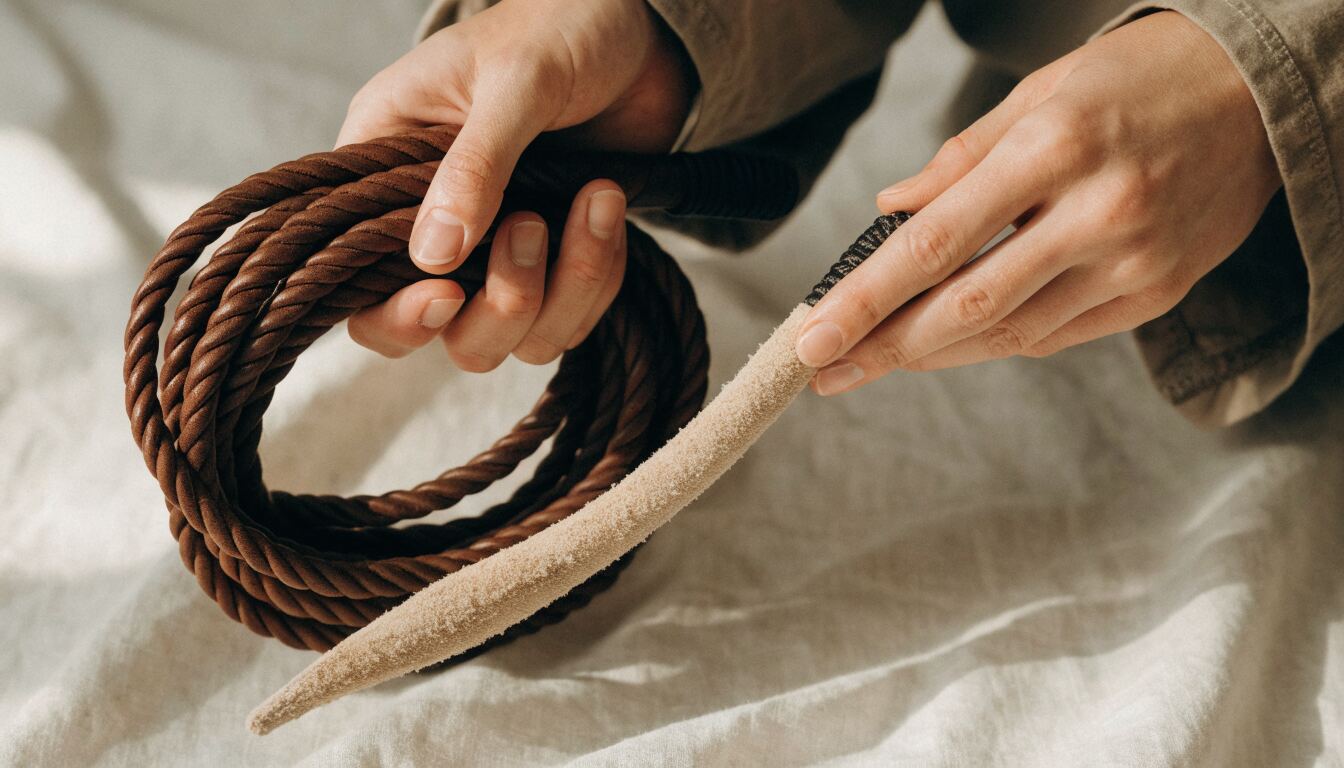
Floggers are perhaps the most iconic and versatile. They consist of a handle from which many strands, or falls, emanate. A flogger made from soft, wide suede falls will feel like a heavy, warm caress, delivering a deep, thuddy sensation. One made from thin, oiled leather or rubber will be significantly more sharp and stingy. The technique can range from a gentle, rhythmic massage-like motion to a more vigorous, snapping strike. They are excellent for covering large areas like the back and buttocks.
Paddles offer a broad, flat impact. They can be made of wood, leather, or even firm silicone. A wooden paddle delivers a solid, intense thud with a bit of sting, while a padded leather one is softer but can still pack a punch. Paddles provide a very direct, substantial sensation and are often associated with a classic spanking feel.
Whips and Crops require more skill and carry a higher risk profile. A single-tail whip, like a bullwhip, can deliver an extreme, focused sting and should only be used by those with significant practice and precision. Riding crops are a bit more manageable, with a stiff shaft and a small leather keeper at the tip. They allow for very precise, targeted strikes that create a sharp, localized sensation, perfect for marking a specific spot or delivering a quick, intense bite.
Canes and Rods are straight, rigid implements, typically made of rattan, birch, or delrin. They are famous for their intense, sharp, stingy sensation. Caning is an advanced skill because the force is concentrated on a very small surface area, which can easily break the skin if done incorrectly. It requires thorough knowledge of anatomy and careful control.
Decoding the Sensation Spectrum: Sting vs. Thud
Understanding the difference between a “stingy” and “thuddy” sensation is fundamental to choosing your adventure. This is the primary language of impact play.
A stingy sensation is sharp, quick, and surface-level. It feels like a snap or a bite. It tends to wake up the skin and create a more alert, energized feeling. Tools that are light, thin, and fast-moving, like canes, thin whips, or the tips of a flogger, produce a sting. The sensation is often described as bright and hot.
A thuddy sensation is deep, rumbling, and penetrating. It feels like a bass note that resonates through the muscle. It’s often perceived as a more grounded, relaxing, and heavy feeling. Tools that are heavy, broad, and slow-moving, like a large, soft flogger or a padded paddle, produce a thud. This sensation can feel warm and soothing, even at higher intensities. Many players enjoy mixing these two sensations to create a complex, layered experience—a few sharp stings followed by deep, soothing thuds.
Mastering the Dial of Intensity
Intensity in flagellation is a multi-dimensional dial, not a simple on/off switch. A skilled practitioner uses all of these variables to craft a dynamic and safe experience:
- Force and Speed: The obvious one. A hard, fast swing will be more intense than a slow, light one. However, a slow, heavy drag can be just as intense in a different way.
- Rhythm and Pattern: A predictable, steady rhythm can be hypnotic and soothing. A broken, erratic pattern can be surprising and create a sense of alert, unpredictable excitement.
- Target Zone: The same strike will feel completely different on the fleshy buttock versus the sensitive back of the thigh. Warming up an area first makes it more receptive to heavier impact.
- Tool Selection: As discussed, the tool is the primary driver of sensation type. Switching from a suede flogger to a leather paddle mid-scene is a dramatic shift in intensity and feel.
A responsible approach is to start with a gentle warm-up to bring blood flow to the area, communicate constantly, and gradually escalate the intensity, checking in frequently. The goal is to build a crescendo that works for the recipient, not to rush toward a pre-determined endpoint.
A Practical Guide to Safe and Fulfilling Exploration
Laying the Groundwork with Clear Boundaries
Before any play begins, a detailed and enthusiastic conversation is essential. This isn’t a time for guesswork. Both partners need to clearly articulate their vision for the scene. What kind of experience are you hoping to create together? Is it a light, sensual, and playful one, or a dark, intense, and challenging one? Discuss and agree on specific, concrete limits. For example, “No marks that last more than an hour,” or “absolutely no impact on the lower back.”
Part of this negotiation is also discussing triggers and emotional limits. Someone might be physically fine with intense impact but could be emotionally triggered by a certain phrase or role-play scenario. Laying all of this on the table beforehand is an act of profound care. It transforms the negotiation from a simple transaction into a co-creative process, building anticipation and trust. Remember, a boundary is a gift—it tells your partner exactly how to play with you successfully.
The Indispensable Practice of Aftercare
The scene doesn’t end when the last strike lands. The comedown from an intense endorphin and adrenaline high can be emotionally and physically jarring. Aftercare is the bridge back to equilibrium. It’s a personalized, necessary ritual that tends to the immediate needs that arise after play. Skipping it can lead to a sudden emotional or physical drop, sometimes called “sub drop” or “top drop,” which can feel like a wave of sadness, anxiety, or fatigue hours or even a day later.
What does good aftercare look like? It’s entirely personal and should be discussed beforehand. Common elements include:
- Physical comfort: A soft blanket, a warm drink, a light snack to restore blood sugar, and gentle cuddling or skin-to-skin contact.
- Emotional reassurance: Verbal affirmation, expressions of gratitude and appreciation, and quiet, non-judgmental conversation about what just happened.
- Wound care (if any): Soothing lotion for reddened skin, an ice pack for any minor swelling, and a check-in on the person’s physical state.
- Quiet togetherness: Sometimes, just sitting in silence together, listening to calm music or watching a light show, is the best medicine.
Aftercare is where the intimacy of the scene is truly cemented. It’s a vulnerable time that, when handled with tenderness, can profoundly deepen a couple’s bond.
Seeking Out Quality Education and Community
If you’re intrigued, don’t rely on guesswork or dubious online videos. The BDSM community has a strong tradition of mentorship and education. Seek out knowledge from reputable, experienced sources. Look for books by well-regarded educators that focus on technique, anatomy, and ethics. Online platforms and forums dedicated to kink can be valuable, but vet them carefully—look for communities that heavily moderate for consent and safety culture.
In-person education is invaluable. Many cities have dungeons or community centers that offer workshops on everything from flogger basics to advanced caning techniques. These classes provide a safe space to practice under the watchful eye of an expert. Observing how an experienced top negotiates, wields a tool, and provides aftercare is a lesson in itself. Remember, being a responsible and skilled partner is a journey of continuous learning. The more you learn, the more confident, creative, and safer your play will become.
Frequently Asked Questions
What is the core definition of erotic flagellation?
It is the consensual use of striking implements on a partner’s body to create pleasurable, sexual, or emotionally intense sensations. The focus is firmly on shared exploration and connection, never on inflicting unwanted harm or actual punishment.
Isn’t this type of play inherently risky or dangerous?
When approached with knowledge, clear communication, and mutual respect, the risks are manageable. The critical safety nets are a foundation of trust, explicitly negotiated boundaries, and the use of unequivocal safewords that allow anyone to halt the scene instantly. Education on anatomy and proper tool use is also essential to avoid injury.
What’s the psychological appeal of being on the receiving end?
The motivations are diverse and personal. Many enjoy the intense physical sensations and the endorphin rush that follows. Others are drawn to the mental aspects: the freedom of surrender, the cathartic release of emotion, the profound trust required, or the exploration of vulnerability within a safe power dynamic. It’s a way to feel deeply connected to one’s body and partner.
What are some basic tools a beginner might encounter?
A beginner will most likely start with floggers, which have multiple soft tails and can deliver a wide range of sensations from a light tickle to a heavy thud. Paddles are another common starting point, offering a broader, more substantial impact. Croips with a small tip provide a sharper, more localized sting and require more precision. The material and weight of any tool dramatically changes its feel.
How does consensual kink play differ from actual punishment?
The dividing line is consent and intention. Punishment is forced upon an unwilling person to cause suffering. In BDSM, flagellation is a mutually agreed-upon activity designed for mutual pleasure, growth, or emotional release. The recipient has full control to stop the action at any moment, making it a collaborative act, not an abusive one.
Can you explain the concept of aftercare in more detail?
Aftercare is the essential, personalized care provided after an intense scene ends. It’s a time to rebalance physically and emotionally. This typically involves comforting activities like cuddling, staying hydrated, eating a snack, offering verbal reassurance, and simply being present with each other. It helps prevent emotional crashes and solidifies the trust and connection built during the scene.